• Home
  • Blog
  • Reviews
  • Features
  • TIT for TAT
  • About
Menu

Woolf Wide Web

  • Home
  • Blog
  • Reviews
  • Features
  • TIT for TAT
  • About
hunger-games-world-is-watching-poster.jpeg

Review: The Hunger Games

July 28, 2012

Originally Posted March 24th, 2012 

Though the financial juggernauts known as tweens aren't well-respected for their literary taste, lumping The Hunger Games in with most other Young Adult bestsellers would be giving it short shrift. The first in Suzanne Collins’ trilogy of mega-popular hits quickly distinguished itself as a bleak, yet accessible adventure novel that doubled as an intro to social critiques. Its path to bookstore ubiquity came with many of the caveats that seem hardcoded to the genre’s DNA; forced romances and repetitious plotting are, at this point, par for the course. Despite such missteps that hint at calculated net-widening, The Hunger Games earned its devoted following by offering readers a character, and a world worth investing in. The success is comforting proof that fads can be born with hints of urgency and substance, not just questions of “which boy should I like?”
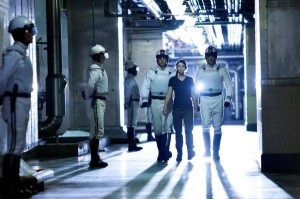
Of course, basing a fictional world around teenagers fighting each other to the death makes for a pretty blunt, but undeniably effective means of getting hooks into readers. Collins brings to the post-apocalypse a disturbing reworking of what it is to grow up; as punishment for a long passed insurrection, the last remaining nation of the distant future forces 24 young people, ages 12 to 18, to engage in televised gladiatorial combat. Each of the states’ twelve districts offers up one boy and girl to do battle in a vast, controlled arena, where the only way out is to be the last “Tribute” standing. At the drawing for the 74th annual Hunger Games, 16 year-old Katniss Everdeen (Jennifer Lawrence) volunteers as Tribute. It’s that, or let her younger sister face certain death in her place.

It’s a pastiche of familiar ideas, a sampler menu of other, undoubtedly more challenging works. The fingerprints of The Lottery, 1984, and even Logan’s Run, are unmistakable. Those “in the know” have been touting the Japanese thriller Battle Royale as the real source of inspiration (if not outright conceptual theft), but that film’s use of blood sport as social metaphor is replaced here with a more deliberate approach.We do, after all, have two more books to set up, so it’s not surprising that roughly half the run-time of The Hunger Games is spent establishing the world surrounding the titular event.
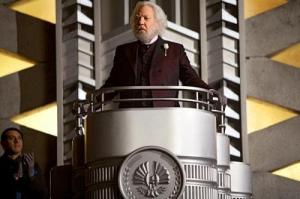
Even at a lengthy 140 minutes, there’s no time for light touches. The gulf in living conditions between Katniss’ Ozark-ian District 12 and the pristine Capitol, a fortified city that hosts the games, is presented in broad strokes befitting names that creative. The abundance of Roman architecture and imagery will clear up any doubts over who are the scrappy upstarts, and who belongs to the “big evil empire”.  An American Idol-inspired training period for the Tributes offers similar opportunity for easily identifiable satire. A takedown of voyeurism and artifice in reality programming would have had more bite, say, ten years ago, but it flies well enough thanks to a healthy dose of self-awareness.

Katniss transforms in front of the viewing public from standoffish loner to popular crowd-pleaser, thanks to a new look from her mandatory but supportive costumer, Cinna (Lenny Kravitz). Don’t expect a fluffy montage of trying on dresses at the mall. For once, getting a makeover is a justified plot driver, as catching the eyes of those who can influence the games is a necessary strategy. Director and co-scripter Gary Ross keeps the gruesome reality of kill-or-be-killed as mostly an undercurrent during the lead-up, allowing some fun and momentum to build in scenes that could have wound up maudlin.

Ross’ best work is brought out in the early quiet moments, which benefit from being just that. James Newton Howard keeps his score tactfully reserved in the opening half, letting you soak in the big moments through looks and gestures. Even in blockbuster filmmaking, a buzzing fluorescent bulb will let you know the air has gone out of the room better than any orchestra. The silence that accompanies the start of the games makes for what is, perhaps, the film’s most accomplished moment.

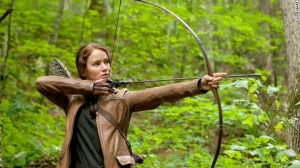
From that point on, The Hunger Games kicks into its high gear back-end, one no less prone to bouts of sputtering. It seems the only thing messier than an underage bloodbath is trying to film it within the boundaries of a PG-13 rating. Persistent shaky-cam is a practical solution to keeping the nitty-gritty of murder safe(ish) for youngsters, but the sense of discombobulation it can produce is off-putting. It’s a good thing Katniss specializes in the bow, because the fracas of close-range combat would have robbed her actions of appreciable impact.
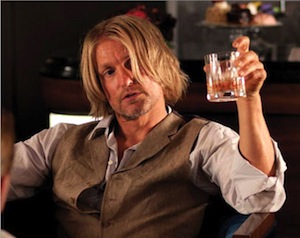
It is, after all, Katniss’ story from word “go”, leaving the non-fodder supporting cast as either thinly sketched, or relegated to simple introductions. Josh Hutcherson and Liam Hemsworth form the base of a requisite but mercifully contained love triangle, with Hutcherson as fellow District 12 Tribute, Peeta. Donald Sutherland gives an intimidating turn as the authoritative President Snow, but is largely kept in the wings, with promise of greater malevolence to come in the sequels. Woody Harrleson gets the most love of the secondary players as loutish former champ Haymitch Abernathy, who’s tasked with training Katniss and Peeta. The kinds of sponsors he wants for Katniss, and the ones he could use himself, are quite different.

Though well-established as a “wildeness girl” following her revelatory performance in Winter’s Bone, Lawrence proves more than capable at mixing that same stoic resolve with the emotional grounding required of the, occasionally forced, tender moments. Survival is a pretty utilitarian personal journey, which is often limiting, but Katniss doesn’t need a grand arc because she’s given credit as a compelling character from the start. The great economy of the film’s early scenes does little to undercut our rooting interests; Collins has crafted a heroine that’s efficiently realized and eminently watchable.
It’s easy to find fault in something insanely popular if you’re among the many left out of the loop, but, all told, this is an enjoyable film. There are still plenty of yet unmentioned nit-picks; the climax is rushed, and life-saving plot devices abound, but it’s tolerable because there’s so much to enjoy at the core of The Hunger Games. No, it’s not high-art, but there’s something encouraging, if not downright exciting, about a mature, well-executed piece of popular fiction that plays to the fans, while being inviting to the uninitiated. Throw my name in with those cautiously optimistic about the next serving.

4 out of 5

The Hunger Games

Directed by Gary Ross

2012, USA

In Reviews, Yeah! (4 out of 5) Tags Battle Royale, Donald Sutherland, Gary Ross, Jennifer Lawrence, The Hunger Games, The Hunger Games movie, Winter's Bone, Woody Harrelson
Comment

Review: The Dark Knight Rises

July 20, 2012

Well Bat-boys and Bat-girls, it's finally here. After years of internet speculation, months of binging on promotional material, and more than a few movie tickets bought as a shameless excuse to watch the new trailers, The Dark Knight Rises is here. Christopher Nolan's genre redefining take on the Batman mythos glides into theatres aloft on the praise of audiences and critics alike, but faces the infamous foe that is the finale. So, have Nolan and company stuck the landing, or is the burden of expectation too great to bear? Is The Dark Knight Rises the "Return of the King" or a super disaster of Spider-Man 3 proportions?

The answer is… it's "Jedi". "Rises"is to The Dark Knight saga what Return of the Jedi was to "Star Wars." Wait, wait! Douse the torches and sheath your pitchforks; there are no fuzzy teddy bears or toy tie-ins to be found here, the comparison is meant as a compliment. As many of us had hoped, Bruce Wayne's journey as the caped crusader Batman comes to a definitive, satisfying end, synthesizing the character study that was Batman Begins with the greater thematic aspirations of The Dark Knight into a package that feels whole and complete. Some will find a few niggling questions remain unanswered and criticize the door being left ever so slightly ajar for someone else to pick up the franchise mantle, but it's clear that Nolan but it's clear that Nolan has stretched this comic book adaptation/myth making exercise to its absolute limit.

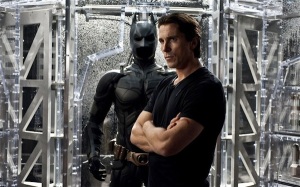
But just like "Jedi" however,the payments made to satisfying the grander narrative are at the expense of the final instalment itself. The huge shift in scope and ambition between parts I and II created a gulf for the trilogy as a whole that "Rises" spends most of its first act filling in. There's a lot of catch up to play when returning to Gotham eight years after Batman shouldered the blame for Harvey Dent's crimes at the end of The Dark Knight, and everyone's out of their element. As Commissioner Gordon (Gary Oldman) struggles to maintain a lie that cleaned up Gotham's streets, Bruce Wayne (Christian Bale) retreats further into solitude in his rebuilt Xanadu of Wayne Manor, having retired from nights of jumping off of rooftops to nurse a broken heart and a lack of purpose.

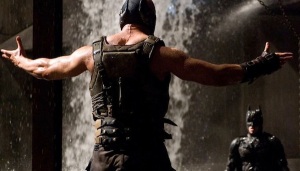
With great speed, a bevy of new players enter to shake up the peace. There's Miranda Tate (Marion Cotillar), an alluring CEO looking to save the world by getting into bed with Wayne industries, John Blake (Joseph Gordon-Levitt), a rookie cop who understands Bruce better than anyone, and Selina Kyle (Anne Hathaway), a jewel thief looking for a fresh start with a new identity. But the real catalyst for Batman's return is a new threat, the hulking beast Bane (Tom Hardy), who rasps and wheezes like Vader through an analgesic mask, and has designs for Gotham nothing short of total annihilation.

An exhilarating and beautiful opening plane hijacking (as in, one plane lassoing another midair) launches things spectacularly, but early signs of turbulence come about from the half a dozen plot lines frantically racing towards their required destinations. The instances of contrivance and convenience that detracted from The Dark Knight pale in comparison to the happenstance on display here, and numerous scenes feel like nothing more than setup without the memorable quips and sardonic humour the first two scripts had at beck and call.

With "Rises," Nolan has completed the transition from superhero movie to all out epic, one describing a modern day apocalypse of dizzying magnitude. People talking about the film's awards potential could point to its "and the kitchen sink" approach to weaving in every contemporary boogeyman Oscar voters like to reward, from domestic terrorism and Wall st., to civil uprising and weapon proliferation. It doesn't meditate on these ideas too throughly, but keeps their presence a constant as the heroes and villains scramble toward a powerful finale, amping up the sense of dread and despair as Bruce Wayne faces his most agonizing trials yet.

But that's where the film finds its most focussed and satisfying through line, in closing out Bruce Wayne's story by exploring his dependence on his secret identity. It's fitting that the film comes out the same week as the remake of Hara-Kiri: Death of a Samurai, because that's how Bruce functions without the cape and cowl, as a warrior looking for a good death in a world that doesn't want him. With doting butler Alfred (Michael Caine) begging him to hang up the costume for good, Bruce's choice to fight evil physically instead of economically and socially comes into question. Through the endless plot turns, character moments and set pieces, one question comes to centre the film and the franchise as a whole: can Bruce Wayne overcome his inner demons and return to a world he gave up on, or is he destined to go down fighting as the Batman?

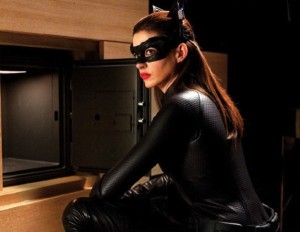
And it's a Christopher Nolan movie, which means thrilling action sequences (save for a criminally stupid continuity error during a motorcycle chase), gorgeous cinematography from Wally Pfister, and one haymaker of a late game twist that makes up for Bane's intimidating but not always engaging presence. And just as Nolan was the first to really understand Batman, Anne Hathaway's spot-on Catwoman is the sultry, badass addition such a solemn affair desperately needed. Having cleared the bar for our expectations so soundly in its first two instalments, it's no surprise that by the final chapter, The Dark Knight Rises ends Nolan's legend feeling all gassed out. But taken as a part of the greater narrative, its a rousing finish, an operatic swan song that's been earned. To hopefully use this tired old phrase one last time, The Dark Knight Rises may not quite be the finale the Dark Knight Saga deserved, but it's certainly the one it needed.

4 out of 5

The Dark Knight Rises

Directed by Christopher Nolan

2012, USA

In Yeah! (4 out of 5) Tags Anne Hathaway, Batman Begins, Christian Bale, Christopher Nolan, Gary Oldman, Hara-Kiri: Death of a Samurai, Joseph Gordon-Levitt, Marion Cotillard, Michael Caine, Morgan Freeman, The Dark Knight, The Dark Knight Rises, The Dark Knight Rises Review, Tom Hardy
Comment
thats-my-boy-poster-640.jpg

Review: That's My Boy

June 17, 2012

At this point, can any Adam Sandler fan not be considered an apologist? Bring up Happy Gilmore and Billy Madison all you like, it's clear that the Sandler of the 21st century could not care less about what you think of him. After an affable and promising performance in Funny People didn't break bank at the box office, it's like he decided that dignity and success were mutually exclusive. This meant starring in three of the worst movies of the last two years, and becoming a record-setter at the Razzie awards (last year, he had twelve nominations…in ten categories). To borrow a lyric from Old Dirty Bastard, Jacques Costeau could never get this low.

Speaking of whom (ODB, not Jacques), what's supposed to entice audiences into seeing another Sandler movie, especially after the audio-visual enema that was last year's Jack and Jill, is that That's My Boy is a hard-R raunch fest. Why that would matter makes no sense, since his heyday was in PG-13 territory, so it's not like this is some grand return to glory. All the rating bump does is give him an excuse to drop F-bombs and talk at length about his dick length, but in a wacky voice. Yay.

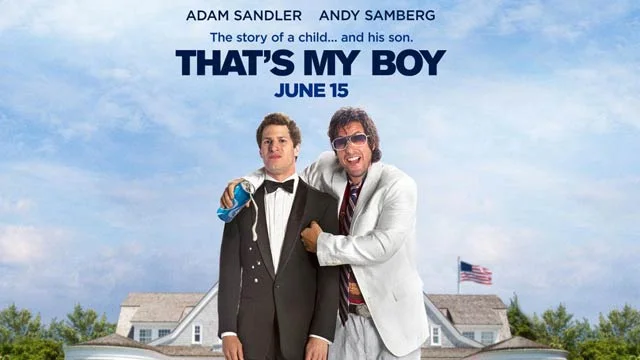
Assuming an accent that sounds like a Bostonian gremlin attempting baby-talk, Sandler plays Donnie Berger, a washed-up party animal who faced, and quickly ran away from, responsibility, having been saddled with a son that resulted from having an affair with his 8th grade math teacher. You have to give writer David Caspe credit for boldness; can you remember the last mainstream comedy you saw that decided statutory rape was a comedic goldmine?

In the moment, they play with the idea that the barely pubescent Donnie can't put his money where his mouth is when Mrs. McGarricle (Eva Amurri Martino) returns his advances. But instead of giving the cocky kid exactly what he wants, only to have it ruin his life (which might create, you know, pathos), they take the low road and have said tryst turn him into a GOD. When Donnie and his teacher are discovered doing the nasty during an assembly, men, women and children give him a STANDING OVATION, like he's finally fulfilled a societal Edu-cus complex by boning the schoolmarm.

Like Jack and Jill before it, That's My Boy takes place in a warped, Twilight Zone-esque alternate dimension where people act like the utter insanity going on around them isn't just typical, but acceptable. Donnie becomes a rich and famous celebrity, not a tabloid target or a guest on Maury, because of his sexual conquest. Even once burnt-out and facing jail time over money owed to the IRS, he's treated as some kind of beer-swilling Adonis, with men saluting him and women dying to be with him. You keep waiting for the pullback to see that the whole movie is just the daydream of younger Donnie, but it never happens. This is a masturbatory fantasy parading around as reality.

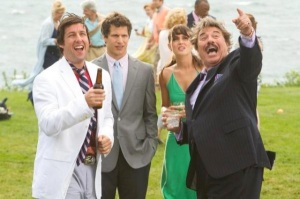
When Donnie hits up his estranged son Han (Andy Samberg) for cash by crashing his classy, New Hampshire wedding, you'd think this might turn into a snobs vs. slobs battle, but instead of Donnie embarrassing his son in front of all the rich folks, Donnie drags everyone else down to his level. There are no comedic straight men in the Sandler-verse, everyone is just waiting to cut loose and join in on the loutish antics of any misogynistic boor who happens to appear. Even for broad comedy, the film doesn't understand that the reason you have snooty rich people act snooty is to create juxtaposition for the jokes. Why is it funny for Donnie to talk about how hot Grandma is if everyone just sorta agrees with him without even batting an eye?

There are no jokes here, just a string of embarrassingly lazy and only intermittently shocking gross-out gags. The ick factor will depend on how many shock comedies you've watched; Zack and Miri Make a Porno had a tremendously funny scene where a guy gets literally shit-faced, but it was an actual joke due to having a setup, and being based on characters that you cared at least a little bit about, on account of acting like human beings. That's My Boy is a series of random and repugnant actions strung together by some of the most egregious product placement you'll ever see. Sandler is almost never seen without a name-brand beer in his hands, with him turning the label toward camera before taking a swig becoming a leitmotif. The apex of sponsor whoring has to be a revival of the Budweiser "Wazaa" ads featuring the whole cast, that they actually have the gall to do twice.

It's a film so sad and vile, that they manage to make an extended cameo by Vanilla Ice somehow not the most desperate thing about it. In an interview, Samberg convincingly claimed that he believed the movie was hilarious, which means his views on comedy are in line with Sandler's, or that he's one hell of an actor. What humour the usually funny Samberg mustered just showed how much better he deserves, as a comedian and an actor. Besides, all were overshadowed by the guy in the back of my theater doing a performance piece by pretending to be someone who'd never heard a four-letter word or seen someone fall down before, squealing with breathless laster the whole time. Maybe this will be another classic from the Sand-man for some, but for everyone else, it's all but an atrocity. To bring back the Wu-Tang Clan one more time and borrow a few words from Dave Chappelle, a comedian who knew how to say no to money for the sake of his pride, That's My Boy is torture, straight torture son.

1 out of 5

Directed by Sean Anders

Written by David Caspe

2012, USA

In Oh God (1 out of 5), Reviews Tags Adam Sandler, Andy Samberg, Billy Madison, Dave Chapelle, David Caspe, Happy Gilmore, That's My Boy, Vanilla Ice
Comment
prometheus-movie-poster.jpg

Review: Prometheus

June 14, 2012

At what point is a child a separate entity from its parent - or can it ever be? It's been 33 years since Alien, time enough for someone to become their own person and begin having offspring of their own. Alien, being the groundbreaking bolt out of the blue that it was, didn't have inherited expectations to live up to. When Ridley Scott announced he would be making a prequel, it had many cautiously optimistic. When that idea soon evolved into something wholly different, but with some traces of Alien DNA, who knew what to expect.

You won't need any paternity test to find the origins of Prometheus, a film all about questions of parentage. It opens with an albino humanoid offering up its body to create the primordial ooze, on this planet or another, it's not clear, but it is provoking. Who are these beings? What is their purpose in creating? And why would they leave us all alone? Lacking nothing for ambition, Prometheus inherited philosophical aspirations from one parent (let's say Blade Runner) but when transposed onto that Alien DNA, the result is a clumsy, laborious hybrid that frustrates as often as it astounds.

Alien fans will pick up on the little connections immediately, like how the title fills in line by line and the old school computer font used for the titular space shuttle's manifest, before a largely identical set-up takes over. A crew following an ancient pictogram star map is led to a distant moon on which an alien presence is immediately confirmed by the presence of an unknown structure, some sort of a crypt or a bunker. Leading the expedition is scientist Elizabeth Shaw (Noomi Rapace), who wants to believe that our real makers are somewhere on this rock, despite holding a crucifix quite dear.

She's not our real lead for a while, as the cast is so deep that we jump back and forth between characters as often as they go from dry-dock to moon-side and back, which is frequent. We get hints at the motivations and personalities of the crew, like the frosty corporate-backer Meredith Vickers (Charlize Theron, making last week's role as the witch in Snow White seem delightful by comparison), before checking in with someone else. "Is there an agenda?" asks Shaw's lover Charlie (Logan Marshall-Green) of Vickers. Since she represents Weyland industries, we already know the answer, but not the specifics.

Ambiguity is Prometheus' bread and butter, which is bold when tackling its greater themes of man's origins and where it is we come from, while refusing to settle on one answer, but too much of that haziness worms itself into the plot. Screenwriters Jon Spaihts and Damon Lindelof move things along through sporadic, episodic events that lack sufficient character motivation, explanation, or both. A sandstorm forcing everyone back to the ship is fine, having part of the crew get lost in the tomb is convenient, but having the captain nonchalantly inform them that there's something awake and moving around inside with them is just bizarre.

The film's most dynamic character, an android named David (Michael Fassbender), is the best developed, though even he seems more capricious than programming should allow. He's served his human masters diligently during their two-year trip, but has he developed a HAL-like distrust for his creators? "Don't all children really want their parents dead," he asks with a hint of… menace, or maybe just curiosity, it's unclear. He seems as interested in finding this species of "Engineers" as Shaw, having studied them for years, which makes for a rather convenient explanation of how he can understand an alien language and their advanced technology, where buttons look like hard boiled eggs and Picard's flute is some kind of password protection.

Those are among the only quibbles one could find with Prometheus as a production though; if nothing else, Scott's knack for gorgeous visuals remains intact. The open vistas of Iceland are awe-inducing and shots of a rolling river are among the most immersive the 3D format can provide. The ship's innards and equipment are at the halfway point between current technology and the point where things are functional enough to allow for some style to creep in. Little details, like how the sound of David combing his hair conveys it's falsity, keep Prometheus' immaculate aesthetic and design in your head at all times.

And while the action is stellar at creating thrills and stomach churns, the story denies satisfaction at every turn. Where Alien built on atmosphere before delivering a singular tale of survival amidst the universe's worst nightmare, Prometheus struggles to balance its visceral vision with its philosophical one, and its beloved heritage only serves to undermine the present product with flashes of old brilliance. Like its enigmatic android, Prometheus looks the part so well that in moments, you can mistake it for the real deal, before the mechanisms begin to lumber away again, trying to find a soul and an identity within the facsimile.

3 out of 5

Directed by Ridley Scott

Written by Damon Lindelof and Jonathan Spaihts

2012, USA

In Meh--- (3 out of 5) Tags Alien, Blade Runner, Charlize Theron, Damon Lindelof, Jonathan Spaihts, Logan Marshall-Green, Michael Fassbender, Noomi Rapace, Prometheus, Ridley Scott
Comment

Review: Men in Black 3

May 27, 2012

Men in Black III is one of those movies that, according to all accepted rules of moviemaking, shouldn't be nearly as good as it is. Here we've got the third instalment of a high concept comedy, that's ten years out from a brutally disappointing sequel, with a lead who hasn't been in a movie in nearly four years, that had an astronomical budget, and a script that wasn't complete at the time of shooting. And to top it all off, it's about time travel, a genre based on the kind of careful forethought and planning that doesn't always mix well with the looseness of a broadly appealing comedy.

But it works, somehow, and its that ability to surprise after all these years that proves to be MIB3's best asset. Oddly enough, this doesn't come through all that well in film's first third, reportedly the only act fully written once filming began. 14 years since joining the Men in Black program, things haven't changed all that much for Agent J (Will Smith), as he and Agent K (Tommy Lee Jones) continue to act as a first response clean-up crew for alien activity in New York that risks exposing the presence of extraterrestrial life on earth.

Smith has been out of theatres since 2008's middling Seven Pounds, and his age lines will clue you in to the time gap since the original Men in Black better than anything else, but you wouldn't know it from the infectious energy he continues to bring with him on screen. His mostly one-sided bantering with the typically gruff K lets the pace roll over all the bits and gags that land with a thud, of which the opening half hour has plenty. Having Emma Thompson make funny noises for what feels like 5 minutes as new MIB leader O is a considerable waste of talent.

What finally kicks things off is the sudden disappearance of K, which despite J's cracks about his age, isn't due to senility. Seems an old enemy of K's, an inventively designed menace named Boris the Animal (Jermaine Clement), has escaped from earth's strongest alien prison (the location of which is worth keeping secret), and has set out to rewrite history with the aid of a pocket-sized time machine. With the timeline altered to facilitate K's death in 1969, J is the only one able to pick up on the change, and follows Boris back in time to prevent K's assassination.

Part of the charm of the Men in Black franchise has been its ability to handle heady, galaxy-spanning concepts and simplify them to their most enjoyable, the results being no different once the series decides to tackle time travel. It's a "fun first" policy that make Doc Brown's guidelines on the matter seem like Stephen Hawking compared to all of MIB's silly quirks, such as a craving for chocolate milk being a symptom of the timeline getting screwy and a climax that rejiggers the rules we've already established with no explanation.

The time travel conceit could have been played off as a gimmick if the rest of the film didn't have a secret weapon that's mostly new to the franchise: character development. As K frequently reminds his partner, the nature of the MIBs is to be emotionally detached and invisible, something J has yet to grasp. When J's temporal trip forces him to re-partner with a much younger, livelier K (Josh Brolin doing an astoundingly uncanny imitation of Jones), it's clear that something bad has to have happened to turn this dapper young gun, who's wooing the younger O (Alice Eve), into the ice cold agent of the modern day. Even J gets his own rushed, yet shockingly affecting, arc during the final act, though it does unintentionally retcon certain elements of the original film.

Completely out of character with most comedies, there's a real sense of personal stakes that accompanies J and K's usual mission to save the world, which creates a backbone for the film to lean on between the entertaining action set pieces, such as a downtown car chase on a pair of uni-bikes that look like the revolving lenses from the opening credits to Game of Thrones. It's unfortunate that the film goes long stretches without being especially funny (the exception being a gut-busting scene featuring SNL's Bill Hader as Andy Warhol), but it's almost always thoroughly enjoyable. And as a bonus, the worn-out sidekicks of the worms and Frank the pug are all but absent this time around, leaving more time for the actual stars.

Men in Black III manages to bring back just enough of the magic which made the first film such a hit that it makes you remember the endless potential the series had when it premiered all the way back in 1997. It modernizes itself in some disappointing ways by being noticeably more violent and vulgar than it's predecessors, but it also develops the universe of the Men in Black by taking to time to develop the characters who inhabit it. If someone could go back and erase MIB2, history books would make a lot more sense; despite how seemingly improbable it may be, MIB3 is the true sequel to Men in Black.

3 out of 5

In Meh--- (3 out of 5) Tags Alice Eve, Emma Thompson, Jermaine Clement, Josh Brolin, Men in Black, Men in Black 3, Tommy Lee Jones, Will Smith
Comment

Review: The Avengers

May 4, 2012

It’s pretty incredible that The Avengers is an actual movie and that it came out in theatres today. How many successful movies have been made by combining two separate franchises, let alone four? Comic books have cross-pollination ingrained in their DNA, particularly Marvel’s, but it was hard to imagine an Avengers movie as being anything other than a cash-in starring a bunch of  easily affordable no-names playing some of the biggest names in comics. So when Marvel decided to give each hero their own film so as to set-up the characters ahead of time and actively build towards this one amazing-mega-ultra-team-up, it showed an actual commitment to the idea of turning a super-group of superheroes into the kind of event movie it deserved to be. Getting geek icon Joss Whedon to write and direct the whole thing seemed itself almost too good to be true.

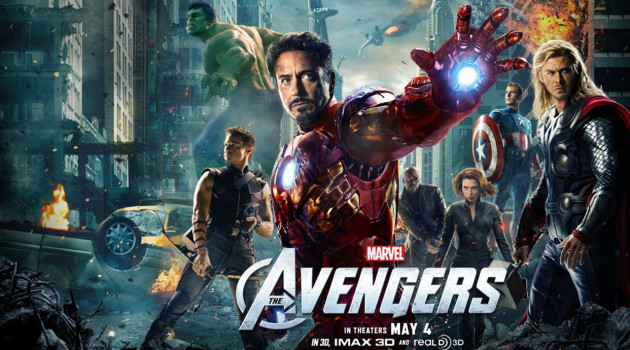
Yet here we are, four years after The Avengers was first teased at the end of Iron Man, with the greatest convergence in cinematic entertainment, pretty much ever, ready to blow audiences away. So, how is it? Well... it’s good, quite good even. That might sound reductive but the fact that The Avengers doesn’t collapse horribly beneath its own ambitions is an achievement unto itself. We have the stars and co-stars of four separate blockbuster franchises all stuffed into one single picture. Robert Downey Jr. is as rakish as ever playing billionaire Tony Stark, who dons the crimson and gold armour of Iron Man once more, but this time he’s joined by supersoldier-turned fish out of water Captain America (Chris Evans), fresh from a nasty plane crash-related hibernation. There’s also Thor (Chris Hemsworth), the warrior prince from another planet who wields Shakespearean verse and a nasty hammer in equal measure, as well as the big green guy himself, The Hulk, being kept in check by Marvel newcomer Mark Ruffalo as the giant’s low-key scientist alter-ego, Bruce Banner.

But wait, there’s more! Increasingly prominent S.H.I.E.L.D director Nick Fury gives Samuel L. Jackson greater opportunity to give grim looks from his one good eye, and has a new assistant (Cobie Smulders) to boot. Superhero scout and franchise connective tissue Agent Phil Coulson continues trying to get his ragtag team of metahumans together, and Thor’s scientist pal Dr. Selvig (Stellan Skarsgard) is in tow as well. Then there’s the pair of assassin types, Black Widow (Scarlett Johansson) and Hawkeye (Jeremy Renner), who’ve been promoted from cameos to full-time world savers. Phew. Even at an arguably excessive 140 minutes, there is a lot going on in The Avengers, with no less than a dozen characters to introduce, both to each other, and audiences still a bit foggy on which one’s the time-displaced WWII vet and which one’s the Norse god.

Despite all the necessary groundwork laying that would hamstring the film’s leading up to it, The Avengers still has so much to get viewers up to speed on that it makes for a talky opening hour and a half. All the more reason to be thankful that it’s Whedon filling in the speech bubbles, as while his direction is clean and focussed, it’s his words that the movie really needed. Rather than settling for a glossy, one-shot crossover, great effort is made to develop the relationship each hero has with the others, while simultaneously maintaining the personalities established in each solo ventures before bringing them into the greater world of super-dom as a whole.

Whedon keeps things light, if not always brisk, with his trademark brand of self-aware humour, including more than a few riffs on costuming, which is funnier when coming from a guy wearing stars ‘n stripes pajamas. Getting everyone to play nice together is the story’s real conflict, as such varying powers and personalities create plenty of friction aboard S.H.I.E.L.D.’s fancy new flying helicarrier. So once Thor’s mischievous brother Loki (Tom Hiddleston) steals the Tesseract, a cosmic MacGuffin that’s been popping up all over the Marvel movie universe, with the intent of leading an extraterrestrial army to earth’s front door, the real threat is whether the heroes be able to survive each other long enough to save anybody else.

It leads to more than a few surprise turns to the established Marvel formula. There’s an emotional and political murkiness throughout, as S.H.I.E.L.D.’s intentions are rarely transparent, and the personal conflicts bear out into much more globally conscious ones. The final act is as action-heavy as ever, with a full-blown intergalactic war ripping apart downtown Manhattan, and these setpiece closers were often the weakest link in the previous efforts, but here, it’s the culmination of 10 hours worth of set-up, so the catharsis is almost unparalleled. It’s a whole lot of CG destruction by monsters whose motives are about as vague as their species name, but it doesn’t matter because holy crap, Hulk just punched a mecha-baleen whale in the face! And wow, Thor just chip-shot an Acura into five aliens! With such a diverse array of badasses, the action beats switch fast but hit hard, even at the 2-hour mark. It’s raw spectacle, pure and simple, but because so much care has been put into making us love who’s putting on the show, it makes for one hell of a pay-off.

And through it all Whedon has, quite improbably, found a way to make every member of the all-star line-up relevant and matter. Hawkeye’s bow and arrow looks pretty measly when compared to the 8-foot tall Hulk, but his accuracy helps out in plenty of situations where smashing can’t. Perhaps most surprising is Johansson as Black Widow, who showed up in Iron Man 2 mostly just as eye candy, but now gets to quip and kick-ass along with everybody else. The team spirit that the Avengers is based on manages to not just survive, but invigorate the big screen translation, and you’ll know it once you see the requisite but charming after-credits sequence (of which there are two, so be sure to stick around). The story itself is simple and occasionally contrived (true to comics, mind-control is a big factor), but it’s built on a foundation of wonderful characters whose interactions within that story are what keep you engaged, be they flashy or funny.

It might seem odd to end talking about another comic franchise but the recently released final trailer for The Dark Knight Rises will likely play before your screening of The Avengers. It gives a stark comparison between what Christopher Nolan is doing with Batman and what Marvel has done with The Avengers. While Nolan wants to create a case for artistic filmmaking within the blockbuster framework, Marvel has once again done what they’ve proven themselves best at; making fun, highly entertaining comic book movies that are effortlessly easy to enjoy. Nolan might be pushing the expectations for the genre, but The Avengers reminds us that just because something’s a spectacle, doesn’t mean it can’t be satisfying. Even better, you can bet there will be plenty of new Avengers fan ready to assemble when the team’s next outing arrives in the (hopefully not too distant) future.

4 out of 5

In Reviews, Yeah! (4 out of 5) Tags Black Widow, Bruce Banner, Captain America, Chris Evans, Chris Hemsworth, Christopher Nolan, Cobie Smulders, Hawkeye, Hulk, Iron Man, Iron Man 2, Jeremy Renner, Joss Whedon, Loki, Maria Hill, Mark Ruffalo, Marvel, Marvel Studios, Nick Fury, Robert Downey Jr-, Samuel L- Jackson, Scarlett Johansson, Stellan Skarsgard, The Avengers, The Avengers Review, The Dark Knight Rises, Thor, Tom Hiddleston
Comment

Review: Wrath of the Titans

May 4, 2012

Originally Posted March 31st, 2012

Though a remake of the 1981 film, 2010’s Clash of the Titans had its roots trace back to the “peplum” fad of the 1960’s, where bodybuilder stars played Greek warriors and gods in campy stories full of cheap sets and unintentional hilarity. “Clash” was a revival of that trends worst aspects, bringing back the wooden acting and plot goofiness of its forbearers but wrapped up in $125 million dollars of CGI and post-conversion 3D. It was not a good movie, not even close, something that would have forced Warner to pump the brakes on their franchise plans had it not made scads and scads of money at the box-office. The newly released Wrath of the Titans shows clear signs that Warner was aware of their mistakes; bringing in new writers and a new director are certainly the best place to start when righting the course of a what could be a $1 billion dollar franchise.

It’s a shame then that, even with the fresh blood, “Wrath” is the same mix of familiar action and goofy mythology that characterized its first outing. Demigod Perseus (Sam Worthington) is enjoying life as saviour-turned-fisherman when apocalyptic parole for the imprisoned titan Kronos threatens to upend his seaside retirement. Deadbeat dad Zeus (Liam Neeson) getting captured by Hades (Ralph Fiennes) is the last straw before it’s time for Perseus to break out the ol’ sword and sandals for more monster slaying and mythological sightseeing.

As a study in Greek classics, “Wrath” takes an everything but the kitchen sink and blender approach, combining characters and creatures from across the Hellenic board and setting the mixture to puree. It’s as big a mess as ever but a noticeably more confident one. That’s partly due to a reworking of the established material that’s just shy of retconning. “The greatest stories are written in the stars” soothed demigoddess and love interest Io at the beginning of “Clash,” though she fails to mention that heavenly bodies are fans of rewrites. She’s absent this go around (read: dead), replaced by queen Andromeda (Rosamund Pike), who was the damsel in distress in part one, but is now a feisty warrior princess. The comic relief is shared between newcomers Hephaestus (a delightful Bill Nighy) and Agenor (Toby Kebbell), who should satisfy anyone wondering what Jack Sparrow would have been like if played by Russell Brand.

The rejiggering does, for the most part, make the gods and men at the centre of the story more watchable. Worthington as a lead still maintains the resonance of old porridge, but Neeson and Fiennes are both more enticing, with increased screen time for the former and less Voldemort-style rasping from the latter. The theme of family remains dominant, a challenge for any writer, considering the kind of cavorting Greek gods are known for. Still, even when dealing in legendary levels of familial vendettas, Perseus’ daddy issues don’t really hold much interest when the fate of the world is at risk.

But it’s hard to expect relationship advice from a series that’s most memorable for the memetic “release the Kraken,” especially when the ads feature plenty of swords a slashin’ and beasties howling. Director Jonathan Liebesman handles most of his action scenes well, using long takes and greater scope than his predecessor to make Worthington’s reaction shots to CG monsters more engaging, save for one noodle limp and incomprehensible Minotaur brawl. They’re a nice showcase for the pretty effects and set designs that assuredly comprised the majority of the film’s budget. Filmed in native 3D this time around, shots designed specifically to exploit the extra dimension are kept to a minimum, and the effect blends in almost unnoticed, for better or worse.

Yet it’s all as dramatically featherweight as ever because the mythology is a veritable Bat-utility belt of writing cop-outs. The powers of godhood are loosely defined so as to fit whatever purpose present circumstances call for (the one consistency seems to be Perseus’ ability to withstand repeated ass-kickings). The gods can now trace back mortal prayers to their origin (thanks Patriot Act!), without much reason for it beyond providing excuse for dramatic entrances. And how are you supposed to understand the stakes of a fight when you’re not sure who’s immortal to what, when and whom? When told that gods don’t die, Perseus replies that, “they do now.” It’s as though he inherited Zeus’ power to simply make something so by saying it.

There’s such a careless, make-it-up-as-you-go sensibility to the film that it becomes reminiscent of a game of Dungeons & Dragons; you can tell those involved had a lot of fun creating this fantasy but lord if it isn’t a dull affair when you’re watching it play out from the sidelines. Wrath of the Titans can hold its head a bit higher than its predecessor, but it’s a modest improvement for a franchise that needed a Herculean one.

2 out of 5

In *Yawn* (2 out of 5)
Comment
the-devil-inside.jpg

Review: The Devil Inside

May 3, 2012

Originally posted January 11th, 2012

“The Vatican did not endorse this film, or aid in its completion.” So reads the opening text of The Devil Inside, a new horror movie that purports to record events surrounding the exorcism of a criminally insane woman locked in a Vatican mental hospital. The filmmakers intended this to be a provocative dig at the Catholic Church, knowing that the Vatican would have no reason to endorse the movie. That’s not just because it’s a faux-documentary that pretends to be based on fact when it certainly isn’t. No, it’s probably because the church giving the thumbs up would be mean they support a film that’s as insipidly dull and scare-free as The Devil Inside is.

With the aim of becoming the next Paranormal Activity squarely in the filmmaker’s sights, The Devil Inside plays like a checklist of that franchises least enjoyable elements. A bland cast of cannon fodder that ranges from forgettable to grating? Check. Hand-held camera direction that sways around aimlessly to give the impression of energy? You bet. An occasional scare from stuff jumping out at you? Actually, there are less of these cheap gotcha moments than you might expect, which would be commendable in a film that had a premise that was both terrifying and original. Sadly, The Devil Inside is neither.

What depth left in the exorcism genre not covered by The Exorcist has been pretty much mined by movies like The Last Exorcism and The Exorcism of Emily Rose, which created hooks out of the question of faith at the center of a rather violent ritual. The Devil Inside confuses awkward commentary on the Catholic Church with depth, and settles for being a painfully slow tour bus of the mildly grotesque. When it opens on a police tape of dead bodies, covered head to toe in blood, is the camera’s indulgent fixation on the film’s FX budget supposed to be scary? Disgusting, maybe, but that’s not the feeling the audience paid $15 for.

The Devil Inside’s only brush with novelty is the conceit that Vatican higher-ups refuse to recognize possession, so it falls to a couple loose cannon Fathers to help young Isabella (Fernanda Andrade) discover the source of her mother’s deadly mania. The priests also happen to be well-equipped medically, so the exorcism scenes have plenty of beeping equipment, so as to give the impression that the film has a pulse.

“No two exorcisms are the same” intones father Ben (Simon Quarterman) to Isabella, as he tries to convince her to stay on her feet and the audience to stay in their seats. Again, the writers fall hard on cliché and act like their set-pieces need to be assembled with complete adherence to the exorcism playbook. Victims violently contorting, shouting nonsense and sexual taunts, or exhibiting random bouts of superhuman strength are bare minimums of the genre, but for The Devil Inside,they’re lazy highpoints. You go in knowing that most of the cast is going to get the axe, but wanting them to die out of pure boredom is thoroughly unsatisfying.

Granted, stupidity is a pretty good way to work up audience bloodlust, something The Devil Inside has to spare. The documentarian recording all the supernatural craziness has the same separation anxiety from his camera all rubes in found-footage films do. Worse, the Vatican experts prove just as inept. One hopes that by their second exorcism, the priests would have figured out that a possessed person won’t have much trouble breaking out of restraints that look like repurposed gift-wrapping ribbons. And you’d think they’d know that the inverted cross that’s etched on their patient, while typically associated with modern Satanism, is actual a symbol of Saint Peter. You know, seeing as they’re TRAINED CATHOLIC PRIESTS.

Even the basic mechanics of the film’s structure bare the unmistakeable mark of incompetence on the part of the filmmakers. Early on, we see professional talking heads from experts in medical and religious fields, giving the impression we’re watching a documentary. That’s completely abandoned once the film picks up the found-footage style, one where the film can inexplicably cut around in the same scene, despite the presence of only one camera. Perhaps the characters thought their inane conversation about the validity of exorcism was worth shooting twice? And since actual dialogue seems beyond the writer’s grasp, we’re eventually treated to awkward camera-confessions straight out of The Real World: Vatican City.

It makes one wonder if found-footage films are more complicated to make then you’d think, or if director William Brent Bell learned absolutely nothing in the 5 years since directing the dreadful Stay Alive. At only 83 minutes, you might think the film’s bafflingly anti-climactic ending was an intentional act of mercy, but that would probably give the creators too much credit. So congratulations to all the other awful movies coming out in 2012; you’ve had one hell of a low-bar set by The Devil Inside.

1 out of 5

In Oh God (1 out of 5), Reviews Tags Fernanda Andrade, Paranormal Activity, Simon Quarterman, Stay Alive, The Devil Inside, The Exorcism of Emily Rose, The Last Exorcism, William Brent Bell
Comment
the-cabin-in-the-woods.jpg

Review: The Cabin in the Woods

May 2, 2012

Between trailers that give away the whole plot, a dearth of original stories, and the stream-of-conscience babbling of social media, it’s hard for a movie to surprise you anymore. So it is with great excitement that I ask you to keep whatever you hear about The Cabin in the Woods to a minimum. Watch the trailer, read spoiler-free reviews (such as this one) and plug your ears as soon as anyone starts talking about it in detail. Do that, and you’re in for one of the most surprising, entertaining and just plain fun movie experiences to come along in years.

You might not assume that, given the succinctness of the title, which provides about as much background info as you’ll need. The film follows five college kids who escape the city to spend a weekend at a remote, foliage-bound retreat. “It doesn’t even show up on the GPS,” says one, while stoner Marty (Fran Kranz) rolls joints in the back of their RV. Good girl Dana (Kristen Connolly) is among the vacationers, having been roped into the trip as an excuse to meet hunky new guy Holden (Jesse Williams). Isolated location? Check. Drugs? Check. Sex? Check. You know the drill.

And that’s the point. If you’re betting there’s a pit stop at a derelict gas station run by a backwoods yokel who warns the kids “don’t go up to that cabin,” congratulations, you’re part of the film’s target demographic; people overly tired of the horror genre. The “teens going on vacation to a secluded location, only to fall prey to malevolent forces” playbook is on full, gleeful display here, featuring familiar character archetypes stuck in an ominous cabin that’s just begging for a coat of red paint.

What you might not expect are the little differences that accrue as we head toward the inevitable killing spree. Despite their inherent disposability, the characters have a charm and likeability that’s unusual for your average slasher-movie fodder. That jock Curt (Thor’s Chris Hemsworth) knows his way around a sociology textbook, as well as a football field, is among the first of many, many, tweaks to the established canon.

It all starts to make sense once you know that the film was co-written and produced by Joss Whedon. The creator of cult-favourites Buffy the Vampire Slayer and Firefly is celebrated for his ability to craft interesting characters through witty and relatable dialogue, something that has survived the big screen transition. That such a grounded voice is behind next month’s big-budget comic book extravaganza, The Avengers, would seem odd, had he not already proven himself a master at repurposing genre conventions, as he did for superheroes in the web series Dr. Horrible’s Sing-Along Blog.

Cloverfield writer Drew Goddard makes his directorial debut here (and also has a co-writing credit), and if these two films share a theme, it’s blowing stuff up. The difference is that The Cabin in the Woods is about mass-destruction of ideas; the filmmakers have set out to destroy or exploit everything you’ve come to expect from scary movies, and they take to the task with style and verve. Though the influx of camera-winking and self-reference in the genre’s recent past has given it some new life (Tucker and Dale Vs. Evil comically spun the same subset of horror last year), Whedon and Goddard take it to such an extreme that the sly wink is more like a proudly flying middle finger.

You could argue that they’re more interested in giving cheeky commentary on established nail-biter tropes than in coming up with real scares of their own, and you’d be right. Fear takes a backseat here, but in its place is an infectious lunacy. If you’ve watched the trailer, you’ll know that there’s more to this cabin than initially appears, as glimpses of the condemned under surveillance hint at a conspiratorial element to the slaughter. It’s no matter to learn that criminally underrated comedic talents Bradley Whitford and Richard Jenkins are among those keeping watch. Who they are, and what their job is, is just the tip of the iceberg.

Their story runs parallel to that of the beset teens, but early impressions of the voyeurs would have you think they’re living in a totally different world. Again, this is all intentional, as what starts as a simple story quickly spirals into territory of such grand, bizarre scope, that it makes the destruction of New York in Cloverfield look like small potatoes. There’s an actual mythology at play here, one that just barely keeps the story afloat, but also filters the entire genre through a new, wonderfully skewed lens.  Nearly every conceivable take on horror gets a shout-out here, with clear references to The Evil Dead, Friday the 13th, even Lovecraft, to name a meagre few. Some shots are so packed with Easter eggs and detail, you’ll wish the theatre had a pause button.

While Goddard’s technical quibbles arise from aping his inspirations a bit too closely (the lighting can be poor and the CGI deserved a budget befitting its ambition), those with any appreciation for gore, monsters or just a good scare, owe it to themselves to see this movie. From its charming beginnings to its balls-out insane third act (complete with an ingeniously twisted finale), you’ll be hard pressed to find a film in recent memory that’s as inventive, or flat-out fun, as The Cabin in the Woods.

4 out of 5

In Uncategorized, Yeah! (4 out of 5) Tags Bradley Whitford, Chris Hemsworth, Drew Goddard, Fran Kranz, Jesse Williams, Joss Whedon, Kristin Connolly, Richard Jenkins, The Cabin in the Woods
Comment

Review: The Debt

September 12, 2011

Originally Posted September 12th, 2010

Audiences are trained to be sceptical; you’re always taking a risk with the $11 you fork over for a ticket and it’s a mentality that makes some films easier to diagnose than appreciate, as one major flaw can almost always overshadow present successes. As crippling defects go, The Debt has a big one, in the form of a major identity crisis. It's not one movie so much as it is three or four smaller ones of varying tone and quality stitched together, smothering those portions of the movie that, had they been expanded, would have made for a more interesting experience. Things start out promising enough; we're introduced to three Mossad agents in the cargo hold of a plane arriving in Israel. It's 1966 and their mission was to kill or capture a Nazi war criminal hiding in East Germany so that he may stand trial for his actions. You get an idea of how things went down when it's just the agents who are leaving the plane. Rachel Singer is given credit for killing the target, a man named Dieter Vogel, whose experiments on imprisoned Jews during WWII made him known as “the surgeon of Birkenau”.

Jumping ahead to 1997, a now retired Rachel (Mirren) is giving a reading about the event from a new book written by her daughter. The father, Stefan (Wilkinson), was with Rachel in Germany. From the way the retired spies look at each other, it's apparent they share a history that their daughter is not privy to. The publication of the book coincides with rumours of new information coming out about the mission, the same day that David, the third team member, has died. It's an effective opening, full of shadows and wan looking faces, everything you'd want out of a political thriller. We then return back to '66, where a younger Rachel (Chastain) crosses over into East Germany to rendezvous with her new partners. It's her first field assignment and the trio meticulously prepare for the difficult task of getting into West Germany with the doctor in tow. It's exciting stuff early on, with plenty of clandestine handoffs and sparring matches, and one nerve-wracking escape attempt that has all the elements of good spy fiction coming together nicely.

Unfortunately, as they so often do, the plan goes awry, so it’s not long before the agents have the target in their possession, but no way of getting him out of Germany. The introduction of Vogel is first-rate stuff, with Rachel doing recon by posing as one of his patients, the prospect of being at your most vulnerable when around a mass murderer providing some very tense moments, but once Vogel is confined to a dingy safe house, things start to fall apart for both the mission and the film. Thriller as a genre is so broad that it's usually paired with other elements, which is why the in the early goings The Debt leans on political elements and its period aesthetics. But once we have our villain front and centre, director John Madden seems to think he's too juicy to keep gagged all film, and it forces The Debt to ditch its cloak and dagger elements in favour of a slower, more psychological approach that hamstrings the narrative momentum.

For trained operatives, the Mossad bunch don't seem to remember that a talking hostage is bad for team morale, giving Vogel ample opportunity to needle and undermine the trio. While actor Jesper Christensen is good, Vogel's over-characterization makes for a preening villain, over clever by half and lacking a believability that would make the political implications of his imprisonment even slightly conflicting. There’s no doubt he’s a monster, but it's a label willingly embraced at the expense of authenticity, and the accompanying tonal shift is made all the more jarring thanks to the romantic entanglements that according to movie law have to develop by having a mixed gender black ops team. Its part Silence of the Lambs, part Twilight, and unfortunately about as enjoyable as you'd imagine such an awkward melange to be. All of which would be more forgivable if it didn't comprise a third of the film, overlong to say the least but also painfully uninterrupted by the sort of intercutting between time periods that breaks up the frustration.

With only a handful of action scenes, there's plenty of character work, but having separate actors play the same person invites comparison, and though we don’t spend quite as much time with the older characters, the gap in acting talent is present almost immediately. Mirren and Wilkinson are both heavyweights and despite occasionally spotty accents they expertly convey the burden of people forced to selfishly and selflessly adopt the status of national heroes in the name of duty and pride. Chastain, who has to do most of the emotional heavy lifting for the young guns, isn't well served by the script, which saddles the younger Rachel with a vulnerability that mostly consists of her doing the “I’m about to cry but won’t” face. Sam Worthington, who comes about as close to actual acting as he's like to get as the younger David, is blown out of the water in just two scenes by a ghostly Ciaran Hinds.

So when we do return to the elder Rachel, thirty years retired but the only of her conspirators capable of tying up a loose end in their story, we get back into the spy thriller that was teased early on, and the improvement is considerable. Mirren is a commanding screen presence and the ease with which she switches from resigned retiree to smooth operator will make you suspicious of little old ladies everywhere. Yet despite the third acts marked improvement, the identity issues persist; there's a stirringly visceral climax but it's the result of the built-up thematic message being thrown under the bus in favour of a last minute turn that's just a hair away from twist territory. The whole affair is the wrong kind of rollercoaster, rising and falling in quality with such sharpness that the whole experience comes across as one big deflating clusterfuck. Those digging for the truth in The Debt will find it, but the good movie that could have been is buried still deeper.

3 out of 5

The Debt

2011, USA

Directed by John Madden

In Meh--- (3 out of 5), Reviews Tags Ciran Hinds, Helen Mirren, Jesper Christensen, Jessica Chastain, John Madden, Sam Worthington, Silence of the Lambs, The Debt, Tom Wilkinson, Twilight
2 Comments
begginers.jpg

Review: Beginners

August 27, 2011

Any relationship is a balance of give and take, at its most base in the form of objects but more importantly, and personally, in the form of shared thoughts and experiences. In particular, it's the things that have hurt us that are often the hardest to impart, usually seeming so singular and specific that it's impossible to think of how another person would understand our pain, let alone want to share in it. Beginners, a new film from Mike Mills, explores what happens when a relationship is founded on two people sharing their pain, in this case, the pain caused by the people who try to harm us the least, parents. It’s 2003 and Oliver Fields (McGregor) has just lost his father to cancer. In the few years between his wife’s death and his own, Hal has come out as an openly gay man, a surprising revelation for Oliver but one which is well founded. As the film jumps between time periods, we see a young Oliver growing up in a house where romance was a peck on the cheek and his mother’s thinly veiled frustration develops into a playful yet unconventional parentage with her son. She’s making the best of a bad situation to be sure, but it still leaves him without guidance as to how a relationship of more than platonic love can work. “I don’t want to be like you and mom,” he tells his father Hal (Plummer), whose new lifestyle Oliver fully supports but can’t help partly resenting; what kind of a blueprint for married life does he have when the one his parents showed him was a complete lie?

The thought that our parents are so stoically in control that we don’t need to worry about their problems is a comforting one, so when Hal faces the difficulty of starting over again in his autumn years, it’s understandable that Oliver is at a complete loss when trying to help him. Past loves for the thirty-something graphic designer are summed up in a flip-book of ex-girlfriends, each dated no more than a couple years, sometimes many years apart, each fallen in love with despite the certainty that things wouldn’t work out. While he remains a big presence in his father’s new life, Oliver is ill-equipped when it comes to giving Hal lessons on love when he never received them from his father in the first place, like a patient asked to analyze his shrink. Which is exactly how Oliver meets Anna (Laurent) at a costume party, he dressed as Freud, initially warming her up with in-character questions about her parents before having the conversation turned on him when they go back to her plush hotel room the same evening, two months after Hal’s death. She’s an actress, constantly travelling but unable to confront relentless phone calls from her disturbed father. It’s a situation Oliver can sympathize with and the two begin a romance borne out of the unsexiest of topics, father issues.

Based in part on writer-director Mills’ own experiences, Beginners is nothing if not heartfelt and for a film advertised as a dramedy, it skews far more towards the prefix than the suffix, which would have made for a maudlin affair if it weren't so earnest and sadly funny. Used as Mills' surrogate rather than a soapbox, Oliver bares a believable despondence, his detachment no more evident than when he lists off the steps that take place between a person passing and their material exorcism from your life, a devastatingly frank showcase of where he is, stuck with a loss that’s past mourning but a very long ways away from acceptance. Oliver’s pessimism threatens to overwhelm the visible happiness he had with his father and the future he could have with kindred spirit Anna, and the relationships are wonderfully realized by the three talented lead performers,  especially McGregor, who exudes an at times powerful melancholy . Venerated actor Christopher Plummer brings the perfect mix of motives to Oliver’s memory of Hal, portraying him as a father who affably wants to stay close to his son while transitioning into a new identity, but also as a man who naively ignores the collateral damage caused by his thirty-year sham of a marriage.

Mélanie Laurent as Anna shines equally, finding a depth and honesty that justify how a person so radiant could divorce themselves entirely from the notion of a relationship ever working out, making a life of hotel rooms and travel sound reasonable when all you want to do is avoid the repercussions of coming to know someone. She’s not so much a manic pixie dream girl as she is a manic-depressive dream girl, making her attraction to Oliver wholly more believable and satisfying. And despite the sizeable star power, the film has an indie spirit, featuring most of the perks and warts that come with the pedigree. Mills’ makes effective use of slideshow photos showing how relationships both hetero and homosexual have changed between two generations and the clever use of multiple time periods make for some of the film’s most touching little moments.  Common caveats of this sort of picture surface though, such as how Oliver and Anna meet in a textbook example of the infamous meet-cute and a great deal of the film’s levity is the result of Oliver’s adorable Jack Russell terrier Arthur, who occasionally quips in with subtitled commentary. Cliché is perhaps overly present and Mills’ elegizing creates bits of dialogue that land with a thud but these conventions and flaws stand out mostly because the whole of the picture is so personal and sincere, maintaining an endearing quirkiness that rarely comes off as cloying.

In the way that only small films can, Beginners works as a kind of highly polished home movie featuring unaware subjects, one that focuses on a microcosm of characters experiencing situations instead of reacting to them. The story moves and the people change, some more than others, but never in a way that feels contrived and the film manages to be moody without ever resorting to dramatics. Even without intruding outside forces, it can take more than two people simply wanting to be together to make things work. Beginners doesn’t offer much in the way of solutions, which is more fitting than frustrating; relationships, whether with family or strangers, wouldn’t mean much if we’d perfected them already. Being with other people is equal parts discovering who they are and finding out how you can possibly live with them.

4/5

Beginners

2011, USA
Directed by Mike Mills

In Reviews, Yeah! (4 out of 5) Tags Beginners, Christopher Plummer, Ewan McGregor, Mélanie Laurent, Mike Mills
Comment

Review: Conan the Barbarian (2011)

August 21, 2011

To those outside its cult following, it would appear that 1982’s Conanthe Barbarian has earned a reverence seemingly leagues beyond its surface quality. Often credited as being the breakout role for Arnold Schwarzenegger, the swords and sandals epic follows the titular Cimmerian warrior from Robert E. Howard’s pulp novel series as he fights monsters, warlocks and a thick Austrian accent with equal measure. There’s a reason it’s a full twenty minutes into the film before we ever hear Conan speak. It’s unabashedly in love with Howard’s world, but dated visuals and an overabundance of camp make watching the film today an entirely different experience. Even James Earl Jones can only bring so much gravitas to a villain named Thulsa Doom.

What really endeared audiences and cemented Conan as one of the essential films of 1980’s, was director John Milius’ epic scope, which emphasized the larger than life aspects of the Conan character to make his story borderline legendary. Sure, watching Schwarzenegger and foes awkwardly throwing each other around like roided out Godzillas sans Tokyo is corny, but in the film’s mind these were battles of titanic proportions. The same sense of grandeur finds its way into the character’s sparse yet weighty dialogue, as though the struggle of Schwarzenegger to spit out his lines make them somehow more powerful. It’s what happens when a film masks budget constraints by distracting the audience with unbridled confidence and an infectious sense of adventure. Which might explains why a studio exec would look at the Conan franchise twenty years later and think it’s ripe for a reboot; if it’s a story and character that people love, why not repackage them for today’s audiences?

And a repackaging is exactly what horror-movie-rebooter Marcus Nispel has created in Conan the Barbarian, a film so focussed on aping the standards of modern action films that it completely abandons the spirit of the original film. While it maintains the major story beats of its namesake (child barbarian loses family, swears revenge, took his father’s sword etc.), the mythic aura of Conan’s tale is lost specifically because it’s been modernized. The update is so wedded to the idea of being a summer action flick that all traces of Milius’ grandiose scope are either buried or altogether absent from the film, as it instead adopts narrative practices that rely on kinetics over character and visuals over vision. Look no further than the sloppily applied 3D, a staple of recent popcorn films that try to substitute a narrative depth with a visual one in a wasted effort to add nuance and life to a world devoid of any. It’s telling when the commercial-baiting shot of an axe coming right at the camera gets more of a reaction out of the actors than it does the audience.

Considering his defining character trait is proficiency with a blade, it’s understandable why the screenwriters would throw a battle Conan’s way at every opportunity, but the direction is as chaotic and unfocused as every other contemporary take on swordplay, relying on quick cuts and CG blood to overemphasize the flashier aspects of combat. Say what you will of the original’s clumsy fight choreography, at least the sword swings of the ’82 version bore weight. Here, Conan’s battles with cannon-fodder baddies are nebulous affairs bereft of tension, no more so then when direct dagger slices from CG sand-monsters don’t draw so much as a pixel of fake blood. There are fleeting moments of inspiration mid-combat, usually in the form of a particularly gnarly death, but any built-up sense of grit or efficacy usually goes out the window when you realize that the villain’s weapon of choice are sword-chucks (you know, a sword that flips around, like nunchucks).

And despite having the good-sense to make Conan an R-rated adventure, the liberties granted to the filmmakers are largely squandered in juvenile fashion, mostly as an excuse for shots of dismemberment and boobs as opposed to exploring the darker amorality of Howard’s original stories. Schwarzenegger’s stoic portrayal had a moral ambiguity that was much closer to Howard’s vision of Conan as an anti-hero conqueror who was good by virtue of making enemies out of the bad guys. What we’re given instead is a carbon-copy of every milquetoast adventure hero from the last decade, complete with unfounded modern values and hints of light-hearted womanizing that’s supposed to endear the character, resulting in a Conan that is about as much of a barbarian as Jake Gyllenhaal was a Prince of Persia. If the character that your entire film is based around doesn’t live up to his title, what chance does your movie really have?

The shadow of Schwarzenegger’s original performance hangs heavy over Conan, which would make it easy to fault new star Jason Momoa had he not already demonstrated his charisma when playing a similarly savage war lord in HBO’s Game of Thrones. The real culprit here is a script that falls back heavily on tropes of the modern-day shoot ‘em up. Slo-mo projectiles, jumping off of sea-side cliffs, hell, even exploding barrels somehow find their way into a fantasy flick, which would stand-out more if the dialogue didn’t try so desperately to match the action cliché for cliché. When love interest/plot mechanic Tamara waxes philosophical about predestination and fate, the best response three screenwriters could come up with is “I live, I love, I slay and I am content,” a paraphrase of Howard that’s about as reductive a quote from Conan as you’ll find. And who’d have thought a film with so little plot would feel the need to give so much exposition, the nadir easily being villain Khalar Zym feeling the need to, out of nowhere, remind everyone that he’s trying to kill Conan using his own father’s sword, in case the twenty minutes used to establish this subplot had already escaped you.

The welcome upside of the film’s slavish adherence to modern convention is that it’s a mercifully quick affair, although fast pacing and modest runtime serve as yet another contrast to epic, sprawling scope of the original. And while it’s never offensively awful, everything about the film, from the flaccid script to the scatological editing, settles for the underwhelming bar set by the pantheon of bad action movies Conan seems so eager to join. Conan used to seek out the lamentations of his enemies, but now sadly, it’s his fans who will likely be the ones feeling crushed.

2 out of 5

Conan the Barbarian

2011, USA

Directed by Marcus Nispel

In *Yawn* (2 out of 5), Reviews Tags Arnold Schwarzenegger, Conan the Barbarian, Jason Momoa, John Milius, Marcus Nispel
Comment
the-trip.jpg

Review: The Trip

August 14, 2011

In 2002, English filmmaker Michael Winterbottom directed the little seen but aggressively unique pseudo-biopic/documentary 24 Hour Party People, a fictionalized retelling of the “Madchester” music scene of the 80’s brought about by famed news personality and music enthusiast Tony Wilson. The use of handheld cameras gave the film a documentary feel but Wilson (played by TV character actor Steve Coogan) is both omnipresent and omniscient in the film, calling out events before they happen, often while directly talking to the audience. It’s an energetic use of self-reflexivity that ties into the film’s punk aesthetic by recognizing the artifice of trying to mimic the slippery status of what “cool” was at the time, while also chasing after that same status in a modern context, where cultural currency demands self-awareness and reference, or as Wilson puts it, “being postmodern, before it’s fashionable.”

The Trip.jpg

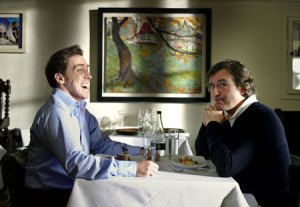
Winterbottom and Coogan reteamed in 2006 for the comedy Tristram Shandy: A Cock and Bull Story, which begins as an adaptation of Laurence Sterne’s hyper-self-aware novel before pulling back another layer and documenting the often professional and always petty struggles of star Steve Coogan, playing “Steve Coogan”, as a kind of prankish meta-humour that’s largely based on the viewers familiarity with him. As if intent on bucking the trend, Winterbottom’s latest film, The Trip, is a largely improvised quasi-documentary following Coogan and comedian Rob Brydon as they tour Northern England reviewing restaurants, a plot summary that would suggest a maturing of the director out of his “punk” decade.  Whereas their previous collaborations were boastfully subversive, The Trip is played entirely straight and dialled so far back that even the title barely registers in the shadow of Winterbottom and Coogan’s last two films.

Pared down from a 6-hour BBC series, the film holds no real plot behind the basic premise and is more interested in the interplay between its two travelling companions than the restaurants being toured. Originally planned as means to impress the girlfriend who recently dumped him, Coogan asks his occasional co-star and sometimes friend Rob Brydon to come along instead and their relationship is the meat of the film. Thankfully, it’s a very funny one as Coogan’s mock disdain for Brydon, particularly his reliance on eerily accurate celebrity impressions, is borne by Brydon with a light-hearted enthusiasm. Even when Coogan calls out his career as mediocre, Brydon takes solace in the words of Bob Balaban of all people, knowing that it’s better to have a career that’s consistent, instead of one that supernovas, an act that Coogan (so he thinks) is trying to repeat.

Despite Coogan’s efforts to establish himself as not just different but superior to Brydon as a comic, the film is often at its funniest when the pair come together, often in the form of tandem riffing to an offhand comment. Two-minutes of car travel produces serious laughs when one realizes that commander’s in costume dramas always demand their troops to be up at daybreak, “they never leave at, you know, 9:30”. Each employs a mix of character comedy and intellectual allusions, with Brydon favouring the former and Coogan the latter, producing on-screen chemistry that’s equal parts chummy and combative. Even when performing duelling impersonations, the two click together perfectly, with Brydon nailing the voices and Coogan adopting the mannerisms, between the two making a strong case for the existence of a kitschy form of comedy.

It’s when they’re apart that the dramatic elements of the TV series interject and it’s likely in these moments that the audience will decide just how much they enjoy the film. The constant barbing back and forth inevitably ends with Brydon coming out on top; despite winning only mock interest and half-hearted scorn from his long time friend, Rob has not only come to terms with but come to love where he is in life. He’s married, happily, a father and relishes his moments in the spotlight regardless of how small, even the ones that don’t even make it into the final cut. Rob has carved out his place in the world and seems damned proud of it, which is the unspoken source of Steve’s disdain, envious of the satisfaction Rob has attained but to proud and self-serious to stoop to what he would consider settling.

Coogan has spent so long on the brink of stardom that the chase has left him worn-out professionally and personally; he’s divorced, in a failing relationship and is a father only when his ex needs him to play the bad-cop to his teenage son. Whether Coogan’s mid-life crisis holds any water for the audience is almost entirely determined by the viewer’s context of him. On its own, the conflict of a B-list actor trying to claw up to a higher strata falls short due to the lack of proper on screen development, with Brydon’s married bliss laid on a little too thick and Coogan’s moping veering dangerously close to maudlin thanks to an intrusive piano score. It’s still often very funny, but the dramatic beats come off as unnecessary, often seeming the chaff that should have been cut from a comedy that’s overlong at 105 minutes.

But when looking at the film as the third entry in what I’ve dubbed the Steve Coogan trilogy (which seems appropriately self-aggrandizing), The Trip transcends its comic trappings and develops a kind of quiet melancholy. Whether it’s seeing Coogan’s sterile stainless steel loft or watching him try to connect with his girlfriend from atop a deserted and snowy mountain, it’s apparent that his ambition has driven him into solitude and it hits hardest of all when you’ve been watching him for nearly a decade. Winterbottom’s meta-narrative gave 24 Hour Party People an edge, while Tristram and Shandy mined the technique for knowing winks and feigned self-deprecation but now it’s 2011 and Winterbottom doesn’t haven’t pull back anymore; “Steve Coogan” the character is so interwoven with Steve Coogan the actor that you don’t know who you’re watching and it’s then that The Trip’s emotional centre finds real resonance. If 24 Hour Party People was his taste of glory and Tristram Shandy his struggle to hold onto it, The Trip may be the juncture that determines the rest of Coogan’s life. To hell with Alan Partridge, the best character Steve Coogan has ever played is himself.

In Reviews, Yeah! (4 out of 5) Tags 24 Hour Party People, Michael Winterbottom, Rob Brydon, Steve Coogan, The Trip, Tristram Shandy: A Cock and Bull Story
Comment

Review: In Bruges

August 2, 2011

“After I killed him, I dropped the gun in the Thames, washed the residue off me hands in the bathroom of a Burger King, and walked home to wait for instructions. Shortly thereafter the instructions came through – “Get the fuck out of London, you dumb fucks. Get to Bruges.” I didn’t even know where Bruges fucking was. It’s in Belgium.”

The opening narration to 2008’s In Bruges serves as a master class in distilling the essential plot and thematic elements of a film into a minute’s worth of exposition. We know our narrator has committed a murder at the behest of someone else but things didn’t go as planned, forcing him into hiding. He’s not alone though and between his thick Irish accent and the mention of Belgium and the Thames, it’s established that the story is European in origin. The peaceful evening opening shots of the titular small town of Bruges contrast sharply with our narrator’s brusque vernacular, such that we know he’s not being put into protection so much as he’s being put into exile. Finally, that we are witnessing his punishment and not his actions exposes that In Bruges is more occupied with consequences than actions, and what follows is a wonderfully original little morality play of assassins, existence and tourism.

When the title card draws up we hear our first piece of dialogue; “Bruges is a shithole,” contends Ray (Colin Farrell), our narrator and newly initiated hitman. “Bruges is not a shithole,” responds his partner and semi-mentor Ken (Brendan Gleeson), a man of the same profession but many years and kills Ray’s senior. Despite differing views on the quality of their getaway, Ray and Ken aren’t a poorly matched odd-couple, they just deal with waiting to hear of their fate with differing tact. Ken, the more level-headed of the two, embraces the prospect of two-weeks in the fairytale-town as a kind of reprieve from a life too long lived; Gleeson’s contentedness masks a world-weariness that’s palpable when he’s not busy baby-sitting his ward. Ray, the younger man, would much rather pass the time getting pissed at the pub than spend it admiring the culture and architecture of a sleepy little town no one has ever heard of. Even when corralled by Ken into seeing the sights, Ray finds a way to ruin the local idyll for not just his partner, but a good number of people from across the world that happen to have come to Bruges.

As it happens, Ray’s skittish behaviour is as much a product of guilt as it is boredom. It turns out that Ray committed two murders on the assignment mentioned in the prologue, one intended and one accidental. He shows no regret over killing his intended target; he’s a hitman, he’s trained for that. What’s haunting him is the life he didn’t mean to take, and it’s Ray’s internal struggle over what he deserves for his actions that forms a foundation for In Bruges’ existential leanings. Bruges starts as an unassuming hideout but as the two outlaws explore it, all manner of symbolic imagery give the town an ethereal quality. The medieval architecture and Christian artwork convey a spiritual atmosphere and in turn, Ken and Ray’s discussions of their work develop a fascinating subtext. The only murder Ken regrets, also accidental, is that of an elderly lollipop salesman who came at him with a bottle but it’s written-off by Ray as self-defence since a bottle is a deadly weapon. “Well, technically your bare hands can kill someone too,” replies Ken, “what if he knew karate?”

The pitch-black humour undercuts much of the deeper questioning posed by the two leads, yet there's a fanciful poetry to this shaggy, morbid story. Whether it’s the author, God, or fate, there’s a higher power guiding the characters, be it in the form of Ray and Ken’s forced exile, or the various folk that populate the town at the time of their arrival. There’s a dwarf actor shooting a dream sequence featuring all manner of extras dressed in animal skin, as well as his dealer, a beautiful Belgian girl who catches Ray’s fancy, and numerous other small characters that nonetheless develop a Shakespearean level of intentional and unintentional involvement in the development of the story. The connectedness of the storytelling, when combined with the singular location, makes the film appear as though it could be adapted to the stage, unsurprising given the directors history in the theatre, and In Bruges is at its most cinematic during its later action sequences. When mob boss Harry decides to take care of Ray’s mistake personally (his reason’s being quite hilariously justified), the film’s third act features a few shoot-out and chase set pieces but given the well-developed characters and heady themes, there’s a weight to the violence that’s refreshing for the genre. In particular, the rarity and import given to guns makes them appear not as disposable thrill machines but as necessary elements of the plot and the deaths they bring are powerful because the film maintains such a modest body count.

With all the veiled musing over death and existence, it’s easy to forget that In Bruges is often brilliantly funny. While Ray’s flagrantly un-PC attitude brings out some great moments (such as the dwarf actor’s tirade about the inevitability of a global race war), the film is welcomingly as interested in subjects such as the banality of a career in professional assassination. When Ken has to pantomime the presence of Ray while on the phone with his boss, Gleeson’s performance wrings every laugh out of the quietly humiliating lengths one will go to in order to placate their superior, even if they happen to be a deadly killer. The script is chockfull of little character details, such that even Ralph Fiennes manages to give off a sense of not just humanity, but normalcy to his portrayal of the gangster Harry, a role that easily could have devolved into caricature. With this film, writer-director Martin McDonagh has established himself as a confident and energetic presence both on the page and behind the camera and his next feature will no doubt draw much anticipation. It’s also destined for scrutiny though because In Bruges is a tough act to follow. It’s funny and well-acted but also maintains a depth and emotional core largely unseen in comedy crime-fiction, and the result is a wholly-unexpected but eminently enjoyable little masterpiece.

5 out of 5

In Bruges

2008, UK

Directed by Martin McDonagh

In F*ck Yeah! (5 out of 5), Reviews Tags Brendan Gleeson, Colin Farrell, Martin McDonagh, Ralph Fiennes
1 Comment

Review: Inception

July 27, 2011

Originally Published: July 18th 2010 

How do you capture a dream, something so surreal and fleeting, that we barely remember it five minutes after waking up? People talk about the dream-like qualities of films by Tim Burton and Terry Gilliam, but few directors approach the things we really dream about. For as much as we think about the impossible while we sleep, it’s seems just as common to conjure up ideas based on ordinary, everyday life. Just think about how many times you’ve had that dream about an upcoming exam or a previous event in your life that you’ve all but forgotten. Filmmakers tend to focus on our more whimsical fantasies but with Inception, director Christopher Nolan dives into the dreams that really stick with us, the ones that seem so real that it’s only after we’ve woken that we realize it was all a mirage.

In the presumably near future, corporate espionage has risen to a level where morally flexible parties resort to extracting secrets from their rivals by accessing their mind through dreams. Cobb (DiCaprio) and Arthur (Gordon-Levitt), a pair of such extractors, are propositioned by a wealthy industrialist to do the exact opposite, insert an idea into a subject in order to control them. The operation is known as Inception. Without much care as to the science or technology driving the plot, Inception quickly establishes the ground rules for dream-invasion; an architect creates the world of the dream while the subject inserts their subconscious into it, whereby their knowledge manifests itself as documents often hidden in secure locations. Akin to what we’ve all experienced, death or a feeling of falling snap participants out of the dream. Simple enough, until it’s revealed early on that there can be dreams within dreams, operated by different architects at each level. If that weren't enough, time grows exponentially with every level, each layer feeling longer than the last.

Only thirty minutes in, Nolan makes it clear that he’s not going to make it easy for the audience. Like much of his previous work, Inception is an elaborate movie, one that drip-feeds you just enough information to keep up. The exposition, rather than forced, feels like a cheat-sheet as the film constantly dares the audience to keep up with it. Things only get more confusing when Cobb’s unbalanced subconscious begins to take over. As it turns out, living in dreams is a dangerous proposition, after all, how can someone exit one reality and accept that the new one is real? While there are themes similar to that of 1999’s The Matrix, Nolan’s take on multiple realities is far more haunting because most people have experienced that feeling of a dream so real that it becomes accepted as the truth. The constant question of what’s real pervades the entire film and will leave it open for wide interpretation in the future.

As convoluted as the plot may be, the film itself clicks along at a methodical pace. At one point planned to follow up 2002’s Insomnia, the complexity of the subconscious spanning plotlines are handled with such timing and precision that it’s clear Nolan knew his story inside-out. Despite the multitude of storylines occurring at varying real-time speeds, the script locks together with a military precision you wouldn’t expect to exist in something as unwieldy as the subconscious mind. The idea that you convert the length of real time minutes into near exact dream world hours seems a bit of contrivance but it’s beautiful to watch in motion. Such an unusually rigid approach to dreams may frustrate some viewers, but it’s intriguing to see how Nolan tries to wrangle together rules and principles based on things most of us have experienced from our own dreams.

Inception barrels forward at an unstoppable pace, especially near the end where just as it seems there’s no way things can get any more hectic, the film one-ups itself.It’s during the many action sequences that the audience may find the time to figure out just how each dream stage affects the others, which is alright because the more complex the story gets, the less enticing the action becomes. There’s an early shootout in Japan and a breathtaking chase through Mombasa which mirror Bond and Bourne respectively and this is where Nolan’s action is best; on a smaller scale where he can use the talent he’s shown directing the action sequences of the Batman franchise. When things get bigger, such as in a traffic jam shootout or the assault of a frozen hospital, the action becomes decidedly more muddled and it’s easy to check out. That’s not to say that there’s an absence of late set pieces; there's a particularly unusual fistfight in the third act that is jaw-dropping. By using the freedom of dreams to full effect, each layer consists of a wholly new locale, from a New York hotel to the previously mentioned hospital in the mountains. The film is consistently entrancing even when the action isn’t because of Wally Pfister's crisp cinematography and the responsibly balanced use of CGI and real stunts.

In many ways it would seem that Inception is a film more concerned with spectacle than narrative but it's a film that continually defies expectation. While the actual plot of the film is just a heist film with a unique objective, the world of Inception and the characters that populate it are entrancing because it seems like Nolan is just scratching the surface of a much bigger universe formed over the last decade. Aside from the two mind invaders, there’s a young architect played by Ellen page who is recruited to both design the dream of the subjects and share the audience’s ignorance as to the specifics of the Inception program. Marion Cotillard appears as Cob’s dead wife but don’t let the trailers fool you; she’s not just some distant memory of Cob’s past. As Mal, Cotillard gives a weighty and surprisingly terrifying performance. There’s also an illusionist, a chemist and a number of Batveterans who make up the rest of a large, star-laden cast. It might seem a bit crowded but the performances are stellar throughout, particularly DiCaprio who finds a perfect balance between being suave and constantly on the breaking point.

Like many heist films, some of Inception’s best scenes come from the group of thieves preparing the assault on the mark’s mind only to see their plan go horribly wrong. Yet most of the characters give indication of a much deeper back-story than is being given, as many of them appear to have a long history with mind manipulation. There are references given to old jobs performed by the extractors and the training undergone by marks to withstand mental invasion, all while the mysterious Cobal Engineering is given brief mention as the owners of the government developed Extraction program. It seems like there’s so much more to this universe than one film could possibly cover and even after two and a half hours, my appetite was not satiated. That’s not to say I want Legendary pictures to fast track a sequel for two years from now, but the world of Inception feels so rich that it has replaced the Batman franchise as the property I want Nolan, and only Nolan, to come back to.

Considering how frequently his name appears in this review, you’ll have probably noticed by now how difficult it is to separate Inceptionfrom its creator Christopher Nolan. Like a lot of people, I see Nolan as one of the most reliable filmmakers working right now. In the last decade he’s made five other movies and by my count at least four of them are great films. It’s not just that he makes entertaining movies; it’s that he makes entertaining original movies that perform well with mass-audiences. Even with established properties, such as Batman or The Prestige, Nolan’s worlds are always worth visiting. He in many ways seems like a beacon of hope in an industry where the unoriginal succeed and the the crap usually rises to the top. Inceptionchallenges a lot of things; the notion that original ideas are unprofitable, that carte-blanche direction is dangerous and the idea that a blockbuster has to be zero-recalcitrance fluff.  While Inception may have a few faults, Nolan has created a wholly satisfying and original film that's as entertaining as it is audacious. I can't wait to experience it all over again.

Five out of Five

Inception

2010 USA

Directed by Christopher Nolan

In F*ck Yeah! (5 out of 5), Reviews Tags Batman, Christopher Nolan, Inception, Joseph Gordon-Levitt, Leonardo DiCaprio, Marion Cotillard, Terry Gilliam, The Prestige, Tim Burton
Comment

Review: Harry Potter and the Deathly Hallows Part II

July 16, 2011

Potter fans rejoice? That's the question on the mind of many a fan of J.K. Rowling's landmark series, now that the megahit franchise has released its celluloid conclusion almost four years after the final book, The Deathly Hallows, was released in 2007. Ten years, eight films and $6 billion dollars later, Harry Potter has proven to be one of the most scrutinized and lucrative franchises in cinema history and that the entirety of the wizarding epic was translated into film is truly an achievement. But it’s a bittersweet farewell for some as this marks the end of one of the most entertaining fantasy franchises of all time. Just look at the burgeoning fraternity of young adult fiction books moved to the screen as would-be franchise openers, only to sputter and flop where Potter succeeded and you’ll know that there’s something truly special about Rowling’s masterpiece.

It's tempting, then, to use the release of the final film, Harry Potter and the Deathly Hallows Part II, as an excuse to conflate feelings about the individual product with the emotions that come with seeing a ten-year phenomenon take its final bows. When Harry Potter and the dark lord Voldemort face off in their climactic final battle, is the narrative thrust coming from the two hours you've spent in the theatre that night or the 15+ hours spent watching the preceding films and the many months spent waiting between each part? To look at DHPII in a vacuum, I’m inclined to rate it about as highly as I have all the previous entries, faithful to the source material, but only good, never great films, which is admittedly a little disappointing.

After the enjoyable yet uneven blend of gritty chase scenes and ponderous table-setting that was Part I, anyone who's read the book will know that what's left is all gold. For a 130 minute film, Part II is quick on its feet, opening with a hasty recap before getting starting right where Part I left off, with bank heists and dragon hijackings crammed into just the first 30 minutes. It's less than an hour before the stage is set for a good old-fashioned "hold the castle" battle royale at Hogwarts and I might be alone here but there's something oddly cathartic about seeing the series' most iconic set blasted apart by all manner of magical spells and creatures. Even with the Potter equivalent of Helm's Deep raging outside, the film still finds time for its heroes Harry, Ron and Hermione to move through a greatest hits tour of the school's hidden rooms and secret chambers in search of the horcruxes that keep Voldemort alive.

The relentless pacing will likely irk purists more than usual and if the subtitle didn't make it clear enough, this is absolutely the second half of a whole picture. Characters have a habit of appearing without introduction and accepting the Potter universe's internal logic is mandatory; you have to trust that the plot points raised out of the blue in this chapter were established in earlier ones or you’re going to be left behind. It's breathlessly efficient, as the absence of the quidditch, homework and teen angst filler that bogged down previous entries lends greater propulsion to the welcomely bleak plot. Still, director David Yates' expedience has a tendency to undercut the emotion generated by the staggering body count that piles up, a concession that may upset fans but aids in keeping the film focussed on its real stars, the kids.

Well, the former kids I suppose. Part of the genius of Harry Potter has always been how well it used the fantasy setting to conceal its identity as a coming of age story and the growth of the reader/viewer along with the characters is a chief reason why the series has enjoyed its enduring popularity. After eight movies, the three leads, Radcliffe, Watson and Grint, have come to inhabit their respective roles with a maturity and confidence that has only grown with each film. The real heavy lifting was done by Rowling in creating the characters to begin with, but the actors and their personas have become so intertwined that by finally becoming adults on screen, the actors may have earned a chance to escape the stigma of being known as just the “Harry Potter kids”.

To focus on these three though would be giving short shrift to the rest of Part II’s impeccable cast. Many of the bigger names are relegated to cameos (Gary Oldman literally has less than three lines), but their presence invokes the grandeur and richness of the lore. One exception, sadly, is Alan Rickman as the turncoat Severus Snape, who apparently decided to make up for his lack of screentime in Part I by acting twice as hard in Part II, and the slight hamming sticks out when the rest of the cast is doing their damndest to give the material the appropriate weight. The signature look of the franchise remains intact and the visual effects continue to be a highlight, though seams are understandably present during some of the more grandiose shots. Those looking to invest in the extra dimension will have a fine enough time, as action sequences are numerous enough to distract from the way the 3D gives static shots an awkward staged look.

So if we ignore the baggage inherent to being the final part of the biggest film franchise ever, where does that leave Deathly Hallows Part II? Well, as someone who has read the source material, I’m forced to stick to the old mantra of “it’s good, but not as good as the books”. In terms of filmmaking it’s among the best of the franchise and should satisfy fans of the books and films alike but to compare it to Rowling’s original work is folly, as is so often the case when adapting books to film. But, as said before, it’s hard not to look at this final film without reflecting on the series as a whole. The journey of The Boy Wizard has been an entertaining one, but Harry Potter the film franchise has had an incredible journey all of its own. The whimsical Columbus years were followed by the darker Cuaron and Newell entries, before finally coming of age under Yates, a transition true to the books but incredibly rare in cinema. Though the films didn’t necessarily become better with each year, they matured with each entry, turning into something organic and altogether unheard of, a film franchise that grew up along with its audience.

4 out of 5

In Reviews, Yeah! (4 out of 5) Tags Alan Rickman, Daniel Radcliffe, David Yates, Deathly Hallows Part II, Emma Watson, Gary Oldman, Harry Potter, Rupert Grint
Comment

Review: Horrible Bosses

July 12, 2011

When I first watched The Hangover, I remember there being a niggling sense of disbelief stuck in the back of my head for much of the film. It wasn’t the tiger in the bathroom or the stolen baby mind you; just about all manner of hijinx is fair game in my book when it comes to gross-out comedies. No, what stuck out was how implausible it seemed that the three leads were in anyway friends. I tried to imagine how these guys might hang out when not forced into some crazy adventure but nothing would come to mind, and without that relationship, the buddy-comedy nature of the premise was lost. Instead of cohering, the character archetypes (the straight man, the good-looking one and the wild card, who in this case starts as the new guy before being accepted in the group by film’s end) conflicted so heavily that instead of creating a great comedic unit it broke down into a kind of masochistic-pissing contest to see who could endure the worse abuse for a chuckle.

When looking at Horrible Bosses, a new comedy starring Jason Bateman, Jason Sudeikis and Charlie Day, the characters fill moulds similar to those of The Hangover but with a far more palpable chemistry. There’s little back-story explaining why these three mid-level employees meet up at the bar every night to complain about what sort of humiliation their bosses have put them through that day, and it’s not needed. Instead of trying to outdo one another, the characters bounce off each other with the kind of ease that’s earned from being friends with someone for many years, and it makes sense that they can go from joking to slap-fighting and back again in the same scene without a moment’s pause. Establishing this kind of relationship is paramount to the film’s jovial tone but it's also the foundation of the film's premise, as it has to be believed that these three would trust each other enough to make a pact to commit murder, the intended targets of said murders being each character’s titular boss.

It’s a pitfall-riddled premise, as you need extremely likeable leads and monstrously unsympathetic villains if you want to mine the act of taking another person’s life for humour, and although the plight of the affable leads is clearly identifiable, the film goes out of its way to reinforce the latter requirement almost to a fault. One boss (played convincingly by Colin Farrell), a raging cokehead, plans to dump chemical waste in Bolivian rivers, while another is a vamp trying to black-mail the recently engaged Dale (Day) into an affair. Finally, there’s Kevin Spacey as an unflinchingly awful sales president who’s even more narcissistic and psychotic than Spacey was as Superman nemesis Lex Luthor. While it's commendable that the film wants to get into its potential filled plot quickly, the early scenes with the bosses often feel more like table setting than comedy.

That being said, once Horrible Bosses get's moving, there's rarely a dull moment. Beyond an overt callout to Strangers on a Train, there's a vaguely Hitchcockian complexity to the way the plan of the working stiffs unfurls before inevitably going awry and it's refreshing to see a comedy in which just about every scene is plot relevant. It also helps that the film is often just as funny as one might hope. The ineptitude of the would-be assassins offers a myriad of great gags alone and the aforementioned table dressing pays off nicely one way or another, often in the form of puke, ass and dick jokes. The film certainly earns it's R-rating but never relies on shock value as a substitute an actually joke and some of the funniest moments needn't require the R-rating at all; Day is a masterfully capable physical comedian and can someone turn a car seat into a great prop.

The strength of the script is largely brought out by the impressive star-power Horrible Bosses has at its disposal. Spacey makes for a surprisingly intimidating villain and Aniston impresses for the first time in a decade thanks to playing a character so wildly against type it almost makes her litany of shoddy romantic comedies over the last few years justified. And while Bateman and Sudeikis both hold their own, they're both pretty much dwarfed by Charlie Day. Day's made a name for himself playing the chubby idiot in supporting roles and on TV and it would be easy to blame him for playing some variation of the same character if that character weren't so incredibly funny. He finds the right pitch for every punch line, from mumbling excuse making to a yelling style that's most accurately described as squawking, but he never brings his character past the point of caricature, there's always some kind of twisted logic behind his many screw-ups. It’s a great performance and shows signs of being a breakout role akin to the kind Zach Galifianakis had in The Hangover (to stretch that comparison a bit further).

For as ominous as the set-up may be, there are bound to be some disappointed that the film doesn’t attempt to go darker. In the hands of the Coen brothers, the final product would no doubt have been a grimmer and more surreal morality play, which in itself sounds intriguing and may have perhaps resulted in a better movie, but certainly not a funnier one. It is summer after all and director Seth Gordon focuses strictly on maximizing the laughs per minute ratio while maintaining the film’s lively pace. It’s as if the director set out to prove that he could make a film that, if absolutely nothing else, will make you laugh, a modest goal perhaps but a completely satisfied one. After a brisk 100 minutes, rather than finishing with sentimentality or sequel baiting, the film does what it does best and goes out on a joke. Gordon knows the score; if you want your comedy to be remembered, just remember to be funny first. It may sound counter-intuitive, but even with all the body fluids, violence and murder, Horrible Bosses is a clean, efficient summer comedy at just about its finest.

4 out of 5

In Reviews, Yeah! (4 out of 5) Tags Charlie Day, Colin Farrell, Horrible Bosses, Jason Bateman, Jason Sudeikis, Jennifer Aniston, Kevin Spacey, Seth Gordon
1 Comment

Review: Midnight In Paris

July 4, 2011

Who better to explore the mystique of a city than Woody Allen, a director who has spent much of his career professing a love for his own city, New York? His latest film, Midnight in Paris, is as much about capturing the beauty of Paris as it is about understanding why we romanticize places like it. Perhaps it's that they’re both set in Europe but it's easy to place Midnight in Paris as a companion piece to Allen's also very enjoyable Vicky Christina Barcelona, but Midnight benefits from the director's ability to explore a city on more than mere aesthetic terms and whereas Barcelona worked as an excellent infomercial for Spain, Allen's latest filmis both a wonderful open-love-letter and a keen deconstruction of a particularly North American fascination with the city of lights.

At the final showdown of 1990’s Quigley Down Under, Alan Rickman's character philosophizes that some men are born in the wrong century while others are born on the wrong continent. It's a pat little musing that a screenwriter like Gil, the protagonist of Midnight in Paris, may point to as the kind of banal work he's had to make a career out of as a Hollywood "helping hand," but the feeling of being displaced in both time and space is what drives Allen's latest neurotic stand-in for himself. A literary struggling to start his own writing career, Gil is convinced that Paris of the 1920's was the golden age of society, a nostalgia that's equal parts unfounded and annoying for his vogue fiancée (Rachel McAdams) and her conservative parents who have flown the pair out to the city.

Gil is on paper as stock a Woody Allen lead as they come, prone to many of the requisite Allenisms (alternately stammering and putting his foot in his mouth for example) but giving the lead to Owen Wilson was a canny bit of casting. Wilson's naturally lackadaisical charm undercuts much of Gil’s quirkiness but he's always been able to approach the edge of hysterics just by widening his eyes, and Wilson’s performance has enough bipolar emotional range to communicate how a guy this rich, smart and good looking could possibly be crushed under the weight of his own ennui. Granted, a relationship comedy featuring a passionate yet liberally self-loathing cosmopolitan facing romantic obstacles both personal and existential is well within Allen's safe zone and even the film's supernatural hook isn't too far a stretch considering Allen’s penchant for injecting mystical elements into his films.

The hook, in this case, being that every night at midnight Gil finds himself transported back to Paris of the 1920's to rub elbows and act star-struck around literary and artistic greats. It's equal parts magic and wish-fulfillment as Gil manages to frequently cross paths with Salvador Dali, the Fitzgeralds and Picasso as though they were all the clique at the centre of history's greatest unrecorded sitcom (I’m thinking Friends via Frasier), the rules simply being that midnight is the magic hour. Even when it dips into territory that I’m inclined to describe as Inception-y, the film isn't all that concerned as to why the streets of Paris run like a nostalgia fueled DeLorean, and it's hard to blame Gill for not wondering about the mechanics of the space-time continuum when a drunk Earnest Hemingway is challenging strangers to a boxing match.

Advertising for the film has done a clever job of hiding the real crux of the story but it really is to the film's disservice since it’s always at its best when Gil is hobnobbing through history. The slow corroding of Gil's confidence by his in-laws or his fiancee's passive-aggressive best friend during the daytime is pleasantly contrasted by drinks with Zelda Fitzgerald or discussing art with Gertrude Stein at night and because the script is so loaded with future laureates and cultural icons, it's understandable that Allen's characterizations of these historical figures is largely cursory. Presenting Hemingway as a boozer who's a touch self-serious may lack subtlety but it's a concession for the sack of the audience and it supports the wish-fulfillment nature of the story; the figures we love from history have had their personalities so blown out over time that it's hard to think of them in anything but broad strokes.

Regardless, what the performances may lack in depth they more than make up for in energy. Adrien Brody is positively unhinged in his cameo as Salvador Dali and Kathy Bates as Stein is a great anchor to the films various eccentrics. But the real show-stealer is Corey Stoll as Hemingway, who brings the right mix of frat-boy energy and melancholy to Allen's alpha-male interpretation of the writer and I’m hard pressed to think of a historical figure in a film that I so badly wanted to party with. Finally there’s Marion Cotillard as the woman Gil is willing to break the space-time continuum for and even though their relationship largely hinges on a preposterous stroke of luck (beyond, you know, time travel), Cotillard has the necessary cool and grace to be a nice romantic foil.

Much like how film has taught us that LA is destined for alien invasion and Tokyo is a hotspot for oversized monster attacks, it just makes sense that if ever there was a city with real magic in it, it would be Paris. The opening montage all across the rainy streets reminds you why a city a city so full of history yet bursting with life can be seriously described as magical. And maybe it's been the crushing impatience of waiting for something really great to come to theatres but I was rather disheartened to see a film I enjoyed this much end after a mere 90 odd minutes. It seems unfair to have such great dialogue and characters confined to such a short run-time yet the film left me feeling unfulfilled in the best way possible. The zeal for life Midnight in Paris exudes just left me wanting more, but sometimes being left a little unsatisfied is all for the best. C'est la vie.

4 out of 5

In Reviews, Yeah! (4 out of 5) Tags Adrien Brody, Corey Stoll, Kathy Bates, Marion Cotillard, Midnight In Paris, Owen Wilson, Rachel McAdams, Woody Allen
1 Comment

Review: The Thin Red Line

May 27, 2011

After a second viewing, I've decided that the easiest way to describe Terrence Malick's 1998 film The Thin Red Line is that it's an anti-war movie. In focussing directly on the frontlines of the Guadalcanal campaign of WWII, Malick leaves little room for moments of valour and heroism on the battlefield, much less gesticulating speeches about them. Whether out of a sense duty or fear, American Army personnel charge uphill through the thick grass as fortified Japanese soldiers rain down on them with machinegun fire and artillery rounds, some missing by mere inches, many others felling man after man.  A seething undercurrent of contempt develops for the chain of command that too often mistakes mercy for honour and futility for sacrifice. He's not breaking any new ground here but Malick's vision of battle in the Pacific theatre is uncompromisingly grim and makes no attempt to justify the violence, giving only the barest of context as to why the Americans and Japanese were fighting in the first place.

It's fitting the film was released only 6 months after Spielberg's more widely recognized Saving Private Ryan because unlike most counter-programming (Deep Impact vs. Armageddon, Dante's Peak vs. Volcano), comparing the two films highlights their starkly differing takes on the war genre. Whereas Saving Private Ryan had a small but well defined group of soldiers on a clear mission, The Thin Red Line's characters are as numerous as they are thinly-sketched. Just looking at a poster will give you an idea of the quantity of big name actors Malick attracted to the project, with even more being completely excised from the first cut's 6 hour length. But beyond a rank and a last name, few of the characters seem like actual, well, characters. It's understandable since much of the cast is first introduced mid-combat and what few meatier parts exist, such as Nick Nolte as the glory-hungry Lt. Colonel leading the attack, stand out because of actual dialogue as opposed to the tactical shouting of the battlefield.

In terms of plotting, Saving Private Ryan falls more in line with traditional war films, sandwiching character building between more action-oriented and emotional first and third acts. The Nazis were clearly defined enemies and the path of destruction the protagonists followed as they went deeper and deeper into Europe reinforced the notion that their cause was just. The Thin Red Line meanwhile opens with the peaceful idyll of a tribe in New Guinea, filled with a rich cinematography and score that's all-but contrarian to Spielberg's D-Day landing sequence. It takes a solid hour before any shots are fired, followed by an hour of  unrelenting battle in a cycle that repeats itself a couple  times before the film ends. The mismatch between the Pacific's beauty and the frenzy of combat serves as a poignant contrast, initially, but although Malick's battle sequences are impeccably staged, desensitization becomes a serious factor given the film's sprawling 170 minute length. It's hard to identify or even root for the soldiers given their lack of development and without providing greater purpose as to why taking Guadalcanal was so important, the countless deaths on both sides lack the catharsis of knowing that this had to happen for the greater good.

Saving Private Ryan plays safely within the tropes of the genre which is probably why it's the more well remembered of the two pictures, yet although The Thin Red Line lacks many of the features found in previous great war epics, that's sort of the point. The Thin Red Line isn't just anti-war, it's the anti-war-movie. Over the course of his twenty year hiatus from filmmaking, it's clear that Malick has been doing some heavy thinking. Whereas the most revered of war dramas pry at the lingering feelings left over from wars of the past, Malick's scope goes beyond any single conflict, or at least, any physical ones. It doesn't take long, but once the viewer realizes that Malick has crafted an existential wrestling match disguised as a war epic, TheThin Red Line reveals itself as a contemplative and introspective meditation on the meaning of life and war. What the film may lack in character and narrative focus, it tries damn hard to make up for in ambition. Nature, love, and spirituality are among the heady topics broached via cryptic (and frequent) narration from the various soldiers, and when it's in step with John Toll's striking cinematography, the film gains an almost poetic flow. By sacrificing specificity for scope, the choice of character quantity over quality gives a notion of universalism to the film's themes, so it doesn't really matter that most of the soldiers are indistinguishable from one another and the absence of a clear dichotomy separating the "good guy" Americans from the "bad guy" Japanese sets up some of the film's more thought-provoking moments.

To a point, The Thin Red Line's focus on thematic depth instead of story can be entrancing, but due to his lofty aspirations, Malick's riddles understandably offer little in the way of answers, and given the film's exhaustive length, it eventually becomes easy to tune out. The narration often walks a fine line between enlightening and rambling and the existential overload can make it easy to grow apathetic towards entire themes of the film. The flashbacks of a lovelorn GI are more darkly funny than they are insightful and it can be jarring to listen to the high-brow philosophizing creep into the character dialogue.

Would it have been better cut down to a leaner 2 hours? Maybe, but if this is only half the movie that was originally assembled, I'm inclined to think that perhaps reworking it into a miniseries would have yielded better results. It's doubtful we'll ever see the full story that Malick wanted to tell and I've spent a great deal of this review talking about what the film isn't because it so deftly defies expectation. While by no means a re-invention of the genre, The Thin Red Line brings an unprecedented thoughtfulness to the already bursting catalogue of WWII films, and though it's ultimately a victim of its own ambitions, the sheer audacity of Malick's vision makes this a war movie unlike any other.

In Reviews, Yeah! (4 out of 5) Tags Saving Private Ryan, Terrence Malick, The Thin Red Line
Comment
← Newer Posts


Powered by Squarespace